Guides
The money-making services in a plumbing contractor business
Which plumbing services earn most, judged by contribution per licensed hour, with the named lines and the arithmetic you run on your own records.
What to take away
- The money-making services in a plumbing contractor business rarely match the ones with the biggest tickets. The strongest earners in most firms are camera inspection and leak location, sewer and drain work, water heater replacement, backflow testing, and service agreements.
- Emergency call-outs and long-distance small repairs usually rank lower than owners think.
- Rank your own lines by contribution per licensed hour, not by ticket price. A 900 dollar water heater can earn less per hour than a 250 dollar camera inspection.
- Count every hour the job consumesdrive time, setup, the supply house run, write-up, and a callback allowance.
- Cash timing and staffing decide whether a high-scoring line is actually sellable.
- Rerun the numbers twice a year and after any change in labor cost or territory.
The measure, in named variables
Rank service lines by contribution per constrained hour. Define the terms once and hold them.
Contribution per constrained hour
- Rrevenue per typical job, excluding tax
- Mdirect materials and consumables at actual cost
- Ddirect labor at fully burdened cost
- Tother direct trip costs
Contribution = R minus M minus D minus T
Score = Contribution divided by H
Sort your lines by Score. That ranking is your answer, and it will not match another contractor's. ServiceTitan, Jobber and Housecall Pro all record these fields. The ranking still depends on how honestly the stage times get entered.
The lines that usually score well, and why
Camera inspection and leak location. Almost no material cost, high skill, and the customer pays for diagnosis before any repair. A residential main-line video inspection, run on a RIDGID SeeSnake or a Spartan camera, typically bills $250 to $600.
Acoustic and thermal leak location typically runs $200 to $450. Sold separately, the line scores well. Folded into a repair price it scores at zero, because the revenue line disappears.
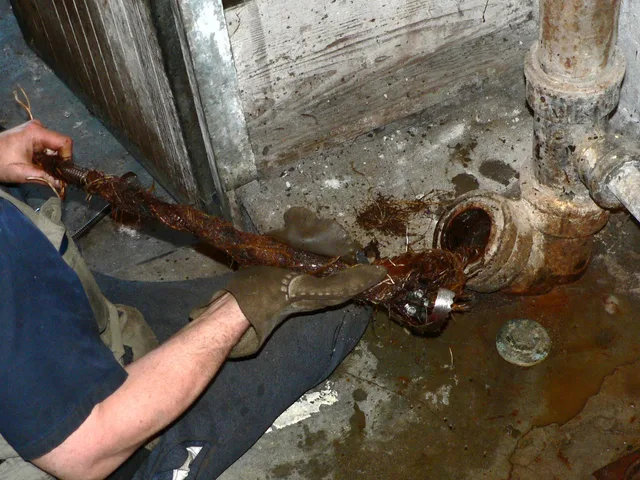
Sewer and drain work, including hydro-jetting. Equipment-heavy rather than material-heavy, so M stays low while R is solid. Cable drain cleaning typically bills $150 to $400, and hydro-jetting $350 to $800.
Jetters from Spartan, US Jetting and Gorlitz cost real money up front. Owned equipment scores better than rented. Measure the callback rate; a drain that blocks again in a month wipes the contribution out.
Water heater replacement. Large R and large M, plus a permit and inspection to coordinate. A 40 to 50 gallon gas tank swap typically lands at $1,200 to $2,500 installed.
Tankless conversions, usually Navien, Rinnai or Rheem units, typically run $3,000 to $6,000 and often need a larger gas line. Rheem, A.O. Smith and Bradford White are the tanks most trucks carry.
The line scores well when the tank is in stock and the swap is routine. It scores badly when a supply house run lands in the middle of the day.
Backflow testing and certification. Small tickets, near-zero material, and a legal testing cycle that repeats every year. A single test typically bills $75 to $200, and most water authorities require it annually or on the schedule printed on the device tag.
Test kits from Watts, Febco and Wilkins are common in the field. The recurring calendar is the asset, not the individual test.
Service agreements and maintenance plans. Modest revenue per visit, near-zero acquisition cost after the first visit, and a system in a known state, which shortens the work.
Residential plans typically sell for $10 to $25 a month, or $120 to $250 a year, and include an annual inspection plus priority scheduling. This is the line most often undervalued on a price-per-visit basis.
Repiping and slab leak work. High R, high M, multi-day H, and a permit. A whole-house PEX repipe on a 1,500 to 2,500 square foot home typically runs $4,000 to $15,000. A slab leak repair typically runs $2,500 to $8,000.
Uponor and Viega supply much of the PEX sold in North America. Contribution per job is strong and per hour is weaker, unless the crew is set up for it and the cash cycle is managed.
Fixture and faucet replacement. Easy to sell, low skill, low R. Labor typically bills $150 to $450 per fixture, plus the fixture, on brands such as Moen, Delta and Kohler. It fills gaps between larger jobs rather than carrying a truck.
Emergency and after-hours work. The premium is real and so is the destroyed schedule around it. After-hours calls typically add $100 to $250 to the standard rate, or bill at 1.5 to 2 times the day rate. Count the displaced jobs in H before calling it your best line.
Getting H right
H decides the ranking, and it is the variable owners understate. For one job of a given type, add:
What counts toward H
- Drive time both ways at your real average
- Setup, floor protection, and teardown
- Time on the work itself
- Any supply house trip for this job type
- Write-up, photographs, invoicing, closing conversation
- Callback allowancerate times average duration
Item six separates lines that look identical. Two jobs at the same price and the same on-site time score differently when one brings you back a tenth of the time.
Pull these numbers from job records rather than memory. The record standard the Internal Revenue Service describes, a system that clearly shows income and expenses with supporting documents behind each entry, is the minimum for the financial half.
The time half needs the same discipline: without recorded stage times you are ranking opinions. ServiceTitan, Jobber and Housecall Pro timestamp arrival, start and finish if the technician taps the screen. A paper ticket rarely does.
Two things the Score does not tell you
Cash timing comes first. A line can score well and still starve you if the customer pays on terms while the supplier wants payment on delivery. Read the ranking next to the cash cycle for each line, especially on water heaters and repipes.
Capability comes second. A high-scoring line you cannot staff is a plan, not a service. Selling more of it depends on the credential and skill mix behind it, the subject of the hiring and training guide, and on whether the truck can carry the work, covered in the equipment and setup guide.
Before you push volume at the winner
- Permission.Does your license cover more of this work in every jurisdiction you serve? Ask the state or provincial board and the local code official rather than assuming the answer travels. Standing obligations are set out in the licensing and compliance guide.
- Safety.Does more of this work mean more excavation, confined space entry, or hot work? Build the controls before the volume arrives. The program structure in the Occupational Safety and Health Administration's recommended practices for safety and health programs is the place to start.
- Demand.Is there enough of this work in the territory, or did the score come from three unusual jobs? Small samples produce confident nonsense.
- Claims.What you say when marketing the line has to be supportable. The Federal Trade Commission's advertising guidance for small businesses requires claims to be truthful and capable of substantiation, which matters most where a line is sold on a durability or savings promise.
Where diagnosis stops and repair begins, and how each line is packaged and priced, sits in the services and packages structure.
Before pushing volume
- Permissiondoes your license cover more of this work everywhere you serve?
- Safetymore excavation, confined space, or hot work?
- Demandenough work in the territory, or three unusual jobs?
- Claimscan you substantiate what you say when marketing?
A worked example of the reasoning
Take two named lines. A camera inspection typically bills $250 to $600, uses almost no material, and consumes under two hours of constrained time. A water heater replacement typically bills $1,200 to $2,500 for the tank, carries a four-figure material cost, and consumes a permit, an inspection and much of a day.
Camera inspection vs water heater
Camera inspection
- Revenue
- $250-$600
- Material cost
- Near zero
- Constrained hours
- Under two
- Permit
- None
- Value driver
- Same-week conversion
Water heater replacement
- Revenue
- $1,200-$2,500
- Material cost
- Four figures
- Constrained hours
- Much of a day
- Permit
- Permit and inspection
- Value driver
- Routine swap, tank in stock
The water heater has the larger R and also the larger M, the longer H, and the permit overhead. The camera has a small R, near-zero M, and a short H. Its value depends on how often the inspection converts into a repair the same week.
Which earns more per hour is not knowable from the descriptions. It is knowable from your records. Run both through the formula and the answer will be specific to your firm, which is the only version worth acting on.
Common questions
Which plumbing service makes the most money?
There is no answer that holds across firms. Camera and leak work, drain and sewer service, and water heater replacement top most lists. Backflow testing and service agreements also rank highly once scored properly. The order depends on your unbilled hour count and callback rate. The formula above gives you your order.
Should I drop my lowest scoring service?
Not automatically. Ask whether it brings work that scores well, whether it fills otherwise idle time, and whether it is priced wrongly rather than unprofitable in principle. Fixture replacement often earns its place as gap-filler.
How often should I rerun this?
Twice a year, and after any change in labor cost, material cost, or territory. A ranking more than a year old describes a business you no longer run.
Is a service agreement worth offering if the per-visit revenue is low?
Frequently, yes, once you score it properly. Predictable scheduling and near-zero acquisition cost change the arithmetic more than the visit price suggests, and the starting decisions behind that are covered in the phased startup sequence.