Guides
What to put in a plumbing contractor business package for a small operation
Packaging plumbing services: five design rules, a three-option ladder, the awkward house test, and how to write a cap that survives a real job.
What to take away
- A package exists to remove a decision the customer cannot make well, not to raise the ticket. Design it from the customer's confusion, not from your price list.
- Bundle only work that shares one visit and one access condition. Two visits is a scheduling liability wearing a package name.
- Cap every variable-scope item inside a package, in writing, and say what happens past the cap.
- Give the customer a real choice between named options rather than a single take-it-or-leave-it bundle.
- Test every package against the awkward house before you publish it.
Start from the decision the customer cannot make
Homeowners calling a plumber are rarely choosing between services. They are trying to answer a question they lack the information to answer: is this going to happen again, is the rest of the system in the same state, and how much is this going to cost me in total.
A good package answers one of those questions. A bad one answers none and simply groups tasks that happen to be adjacent on your menu.
Write the question at the top of each package definition. If you cannot write it, you have a discount rather than a package.
The design rules
Rule 1: one visit, one access condition. Everything in a package should be performable in a single trip with the same access. The moment a package requires a second visit, or requires the water to be off at a time the customer cannot accommodate, its value has been eaten by coordination.
Five package design rules
- One visit, one access condition
- Cap the variable items
- Every item individually recognizable
- Discount equals a saved hour
- Exclusions travel with the package
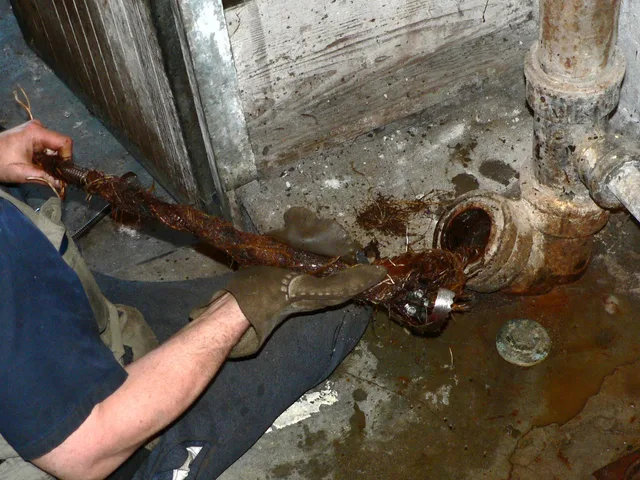
Rule 2: cap the variable items. Anything whose scope depends on what you find has to carry a limit inside the package. A package that includes drain clearing must state how many fixtures or lines, what depth of access, and what happens if the line turns out to be broken rather than blocked. Without the cap you have sold an unlimited liability at a fixed price.
Worked example: a capped drain clearing. The package text, with the blanks filled in, reads: we clear one line, up to 60 feet from the cleanout we can reach, in one visit, and we camera that line afterwards.
The cap is the length and the access point. If the line is broken, collapsed, or behind a fixture that cannot be opened, the cap is reached.
Past the cap the technician stops, photographs the condition, quotes the repair as a separate job, gets written approval, and resumes. No work beyond the cap starts without that approval.
Rule 3: every included item must be individually recognizable. The customer should be able to point at each thing they are receiving. Bundled items nobody can name are read as padding.
Rule 4: the discount must correspond to a saved hour. Price the package as the sum of the parts minus the time genuinely saved by doing them together. If nothing is saved, there is no reason to discount, and the package is a convenience rather than a bargain. Say that plainly instead of inventing a reduction.
The arithmetic, with illustrative numbers. Two items sold separately: drain clearing at $300 and a camera inspection of the same line at $150.
Done in one visit they take 45 minutes less in travel and setup. At a recovered hour worth $80, the time saved is about $60.
The package price is $450 minus $60, or $390, a discount of about 13 percent. The numbers are an example, not a market quote. Substitute your own.
Rule 5: exclusions travel with the package. They belong in the same document, in the same size type, next to what is included.
Three named options and what each one contains
Three named options work better than one bundle, because they turn a yes-or-no decision into a which-one decision. The shape that holds up in this trade is:
- Single line clear.One drain line cleared, up to a stated length and access depth, with a camera check of that line and a written note of what the camera found.
- Main line clear and assess.Everything in Single line clear, plus the camera run through the main line to the municipal connection where access allows, and a short written report on pipe material, roots and low sections.
- Whole house drain service.Everything in Main line clear and assess, plus every fixture trap and reachable branch cleared in the same visit, and a priced list of any line that needs work beyond the cap.
Three-option package ladder
Fix it
- Answers
- Stop the problem
- Repair
- Yes
- Inspection
- No
- Follow-up
- No
- Guarantee terms
- Stated
Fix it and check
- Answers
- Anything else failing
- Repair
- Yes
- Inspection
- Written finding
- Follow-up
- No
- Guarantee terms
- Stated
Fix it, check, protect
- Answers
- Stop recurrence
- Repair
- Yes
- Inspection
- Written finding
- Follow-up
- Scheduled work
- Guarantee terms
- Stated
Two rules make this work. Every option must be complete on its own, so that choosing the smallest is a legitimate choice rather than a punishment. And the difference between adjacent options has to be one idea, not a longer list.
Four questions to test a package on an awkward house
Before publishing a package, run it against the hardest realistic job it would apply to. Pick a house with poor access, older materials, and a system nobody has documented.
Ask four questions.
Four questions to test
- Can the technician reach the work with the access the customer actually has, rather than the access described on the phone?
- Does the cap hold if the pipe is older and thinner than the age of the house suggests?
- If the job reaches the cap in the first hour, what happens next, and is that written down?
- Where no drawing of the system exists, does the package price assume a layout the customer cannot supply?
Awkward house test questions
- Does fixed price cover a normal job?
- Can technician tell inside or outside?
- What is said when cap is reached?
- Does a permit need funding?
A package that fails the awkward house test does not need a higher price. It needs a tighter entry condition.
What you may put on the page
Everything published about a package is advertising. The Federal Trade Commission's advertising guidance for small businesses requires claims to be truthful and capable of being supported, and requires the conditions on an offer to appear with the offer.
That has three practical consequences here.
- A guarantee with conditions has to be described with its conditions, in the same place, not on a separate page.
- Savings claims need a real comparison behind them. Saying a package saves money against separately purchased items means the separate prices have to exist and be genuine.
- Words like complete, full, and total set an expectation you then have to meet. If the package is not complete, it needs a different name.
Delivering the package on site
A package fails at delivery more often than at design. Three habits prevent it.
Path past the cap
- Stop work
- Document the condition
- Quote the extra
- Get customer approval
- Resume work
Confirm scope before starting. The technician reads back what is included and what is not, and records that it happened. Thirty seconds here removes most disputes.
Photograph the entry condition. Evidence that the situation matched what was quoted protects both sides, and it is what makes a cap enforceable without an argument.
Have a written path past the cap. When the job turns out to be bigger, the technician needs a defined route: stop, document, quote the extra, get approval, resume. Improvisation at this moment is how a fixed price becomes a loss.
Some packaged work carries a hazard that has to be handled before the truck moves, particularly anything involving excavation, confined spaces, or hot work. Build the control into the package definition using the structure in the Occupational Safety and Health Administration's recommended practices for a safety and health program, so the sale cannot happen without it.
Reviewing what you published
Every six months, pull the completed jobs for each package and compare them with the definition. You are looking for three things: how often the cap was reached, how often the technician adjusted the scope verbally, and whether the package's actual hours match the assumption its price was built on.
That review needs job records you can query, which is why the recordkeeping standard the Internal Revenue Service sets out in what records a business should keep matters operationally and not only at tax time.
Rank packages by what they actually contribute, not by gross revenue, using the method in the analysis of which services actually pay.
The package definitions belong in the services and packages structure. Truck stocking that decides if a package can be done in one visit is in the equipment and setup guide. The sequencing for a new firm is in the phased startup plan.
Common questions
How many packages should I offer?
Two or three per problem type. More than that returns the customer to the confusion the package was meant to remove.
Should a package always be cheaper than the parts?
No. It should be cheaper only where combining the work actually saves time. Where it does not, sell it on certainty and convenience and say so.
What if the customer wants to remove one item?
Then it becomes separate services at separate prices. A package with items removed is not a package, and letting it be one teaches every future customer to negotiate the contents.
Do maintenance packages work for residential plumbing?
They can, where the recurring work is genuinely useful rather than invented to justify a visit. Be specific about what is checked and what the customer receives, and be honest that inspection reduces surprise rather than eliminating it.