Guides
Should a plumbing contractor business buy new or used equipment without the jargon
A plumbing contractor business can compare new and used equipment by cost per productive hour, downtime, failure risk, and used-equipment inspection.
A plumbing contractor business should compare new and used equipment by cost per productive hour, then account for downtime and failure risk.
- Purchase price is the wrong comparison. Compare cost per productive hour across the period you will actually own the thing.
- The variable that decides most new versus used arguments is downtime, and it is the one nobody puts in the spreadsheet.
- Used is usually right for items with a long service life, a maintenance history, and a resale market. New is usually right where a mid-job failure costs you a day.
- Get the residual value question answered before you buy, not when you sell.
- Do the arithmetic once per item class and reuse it. It takes an evening and it settles arguments for years.
The comparison, in named variables
For any single item, new or used, work out the same five things.
Use these definitions for both options:
- Pis the purchase price.
- Sis the estimated resale or salvage value at the end of the ownership period.
- Nis the number of years you expect to own the item.
- Cis the expected annual cost of maintenance and repairs.
- Uis the productive hours you expect to get from the item each year. Count hours available for work, not just hours on a calendar or an hour meter.
Five variables and the two formulas
- Ppurchase price, delivered and fitted
- Sexpected salvage or resale value
- Nownership period in years
- Cannual running cost
- Uproductive hours per year after downtime
Then:
Annual cost = (P minus S) divided by N, plus C
Cost per productive hour = Annual cost divided by U
Run it for the new item and the used item. The lower cost per productive hour wins, subject to the two tests in the next section that the formula cannot express.
Where the used option usually loses
The formula makes the trap visible once you fill in U honestly.
Used machine: sticker price vs real cost
Looks like
- Purchase price
- half price
- Productive hours U
- full year
- Running cost C
- low
- Canceled jobs
- not counted
Actually is
- Purchase price
- half price
- Productive hours U
- minus lost days
- Running cost C
- parts and repairs
- Canceled jobs
- not in formula
A used machine at half price looks unbeatable until you reduce U for shop days and increase C for the parts it needs. For a machine used weekly, two or three lost days a year is a large share of U.
A lost day costs more than the machine. It also costs the jobs that did not happen and the customers who were rescheduled.
A machine that is idle when you need it has a U of zero for that day, and the day's canceled jobs are not in the formula at all.
Estimate downtime from the seller's maintenance record where one exists. Where none exists, treat the absence as information. A machine with no history is being sold as a gamble, and the price should reflect that.
Two tests the arithmetic cannot do
The failure consequence test. Ask what happens if this item fails in the middle of a job. For a hand tool the answer is a nuisance. For the machine your busiest service line depends on, the answer is a day of canceled work and a set of unhappy customers. Where the consequence is severe, buy for reliability rather than for cost per hour, and keep the old unit as the backup rather than trading it.
Failure consequence test
What happens if this item fails mid-job?
buy for reliability, keep old unit as backup
cost per productive hour decides
The competence test. Some used equipment is cheap because it is worn in ways that are hard to see. If you cannot assess the item yourself, either bring someone who can or buy from a source that stands behind it. Paying more for a machine you can evaluate is cheaper than a bargain you cannot.
An inspection routine for used equipment
Whatever the item, work through the same sequence.
- Start by confirming the make, model, serial number, included accessories, and the seller's maintenance and repair records. Check the recorded hours where the equipment tracks them.
- Next, inspect the frame or housing, controls, guards, cords, hoses, connections, and visible wear. Look for cracks, leaks, improvised repairs, or missing parts.
- Start and operate the equipment through its normal functions. Where it is safe and practical, test it under working conditions and listen for unusual noise, vibration, or changes in performance.
- Check that the accessories work with the machine and that replacement parts and service are available.
- Before agreeing on a price, have a qualified technician assess anything you cannot evaluate. Note needed repairs and include their expected cost in C; keep the inspection findings with the purchase record.
Used equipment inspection sequence
- Read the maintenance record, gaps matter
- Ask why it is being sold
- Run it under load until warm
- Price wear parts before negotiating
- Confirm parts availability for the model
- Record serial number on the receipt
- Confirm insurance and local service
The IRS's recordkeeping guidance, including Publication 583, Starting a Business and Keeping Records, calls for records that clearly show income and expenses. Keep the purchase invoice, payment record, and service records with the asset. You will want them for depreciation, an insurance claim, and resale.
Ask a tax professional how a given purchase should be treated. That treatment can change the comparison, and it depends on your circumstances.
Item classes, and where each usually lands
These are tendencies to test against your own numbers, not conclusions.
Where each item class usually lands
Item class
- Vehicles
- used, documented history
- Large powered machines
- depends on failure test
- Diagnostic equipment
- watch parts and software
- Hand tools
- buy for grip and weight
- Safety equipment
- new, replaced on schedule
Usual answer
- Vehicles
- Large powered machines
- Diagnostic equipment
- Hand tools
- Safety equipment
Vehicles. Usually used, with a documented service history. Service vans are one example. The depreciation curve on a new work vehicle is steep, N is long, and a good mechanic can assess condition. The exception is where the vehicle is also your rolling advertisement and presentation matters to the customers you want.
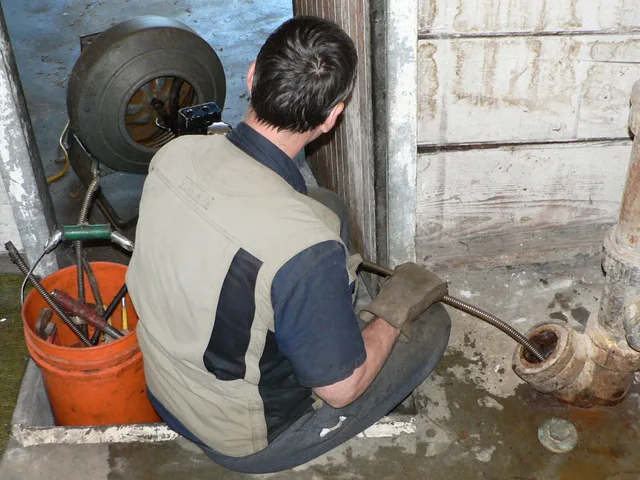
Large powered machines. It depends almost entirely on the failure consequence test. Drain-cleaning machines, water jetters, and excavators are examples. Where the machine underpins your busiest service, reliability wins. Where it is occasional work, used or rented is usually right.
Diagnostic and inspection equipment. Sewer cameras and pipe locators are examples. Watch parts availability and software support, which age faster than the hardware. A used unit with no path to service has a short N regardless of condition.
Hand tools. Pipe wrenches, cutters, hand augers, and press tools are examples. Buy for grip, weight, and durability rather than price. These are used every day, they rarely have a resale value worth modeling, and the difference shows up in the technician's hands rather than in a spreadsheet.
Safety equipment. Personal protective equipment, such as gloves and eye and hearing protection, should be new and replaced on schedule. Personal protective equipment with an unknown history is not a saving. The program that decides what you need and when it is replaced should follow the structure in the Occupational Safety and Health Administration's recommended practices for safety and health programs.
Rental as the third option
Rental belongs in the same comparison. Divide the rental charges for the period by the productive hours you expect to use it to get rental cost per productive hour. Confirm who is responsible for maintenance and repairs in the rental terms, and include any such costs. Rental avoids tying up purchase capital.
There is no universal number of rental days per month that makes buying worthwhile. Before the first rental, compare expected rental spending over the ownership period with ownership cost over that same period, including maintenance, downtime, and resale value. Rent while the expected rental cost is lower; buy when ownership is less costly and the equipment's reliability fits the work.
Treat daily-use, job-critical equipment as core equipment and occasional specialty equipment as a rental candidate. For each item, use the same ownership period and cost-per-hour calculation, then apply the failure consequence and competence tests.
What a purchase can commit you to
Some equipment carries obligations that outlast the buying decision.
Machines used in older buildings may put you into programs you were not in before. The Environmental Protection Agency's Renovation, Repair, and Painting (RRP) Rule requirements for contractors cover firm certification and lead-safe work practices.
Those practices apply to work that disturbs painted surfaces in older housing and child occupied facilities. Buying the ability to do that work means budgeting for certification and containment materials.
Licensing and supervision requirements vary by state and locality. Before buying equipment for work that requires a credential or specific supervision, confirm the applicable requirements with the plumbing licensing board and local code-enforcement office where the jobs will occur. The jurisdiction-specific background is in the licensing and compliance guide.
The training that must come with a new machine is covered in the hiring and training guide.
Common questions
Is used equipment a false economy?
Not as a rule. It becomes one when the buyer estimates downtime optimistically or cannot assess condition. Fill in U honestly and the answer stops being a matter of opinion.
How do I estimate resale value?
From what comparable items with comparable hours actually sell for now, in your area. Asking prices are not sale prices, and a national figure will not reflect your local market.
Should a new business buy new to look established?
Presentation matters for the vehicle and for anything the customer sees. It matters much less for a machine that lives in a compartment. Spend the presentation budget where it is visible.
What is the most common mistake?
Buying tier three equipment early because the price was good. A cheap machine you use twice a year has a terrible cost per productive hour, and the money would have done more as runway. Estimate expected use before buying, then use the cost-per-hour calculation above to test whether the discount makes sense.