Guides
Plumbing contractor service standards compared with what actually happens
What written plumbing service standards promise, what real crews on emergency callouts actually do, and how homeowners can close the gap between the two.
What to take away
- A written standard and the work performed are two different documents. Compare them quarterly, or the crew's version becomes the real one.
- Most gaps come from a standard that describes an intention, such as "protect the area," instead of a finish state someone can photograph.
- Every standard carries six fieldstitle, trigger, steps, result, evidence, owner and version.
- Name the authority, never the code edition. State and local amendments move faster than IPC and UPC revision cycles.
Named standards against the callout
Named sources set the written side. The International Code Council publishes the International Plumbing Code. IAPMO publishes the Uniform Plumbing Code. The PHCC publishes the National Standard Plumbing Code. NFPA 54 covers fuel gas piping.
A written standard describes a repeatable job well enough that two technicians do it the same way.
Practice happens when the van is loaded and the second call is already late. Ordinary reasons pull the two apart: a shortcut that works, a part out of stock, a helper taught the old way.
Which column a job landed in is a quality-control question, and the per-job checks in the quality assurance checklist are how owners settle it.
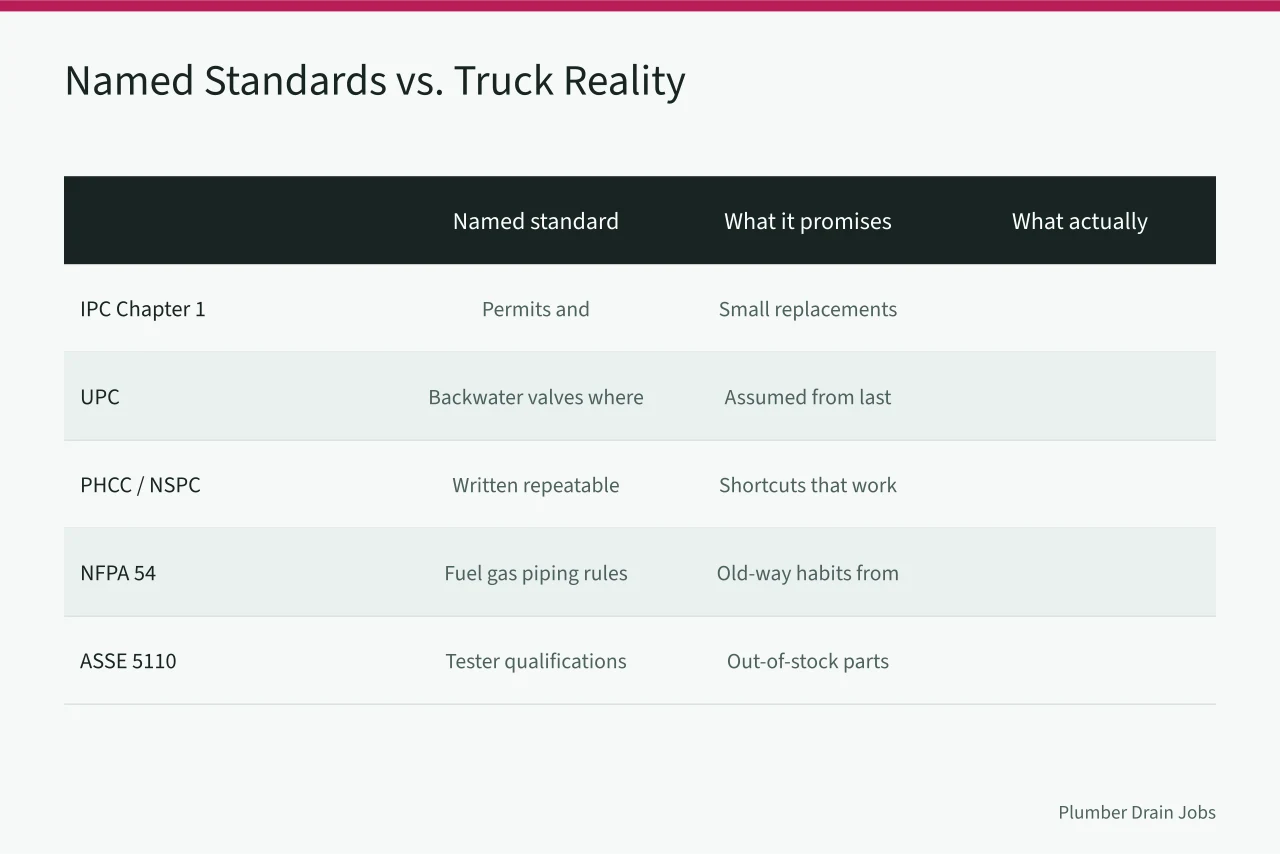
The table below sets the named promise against the callout.
What it promises
- International Plumbing Code, Chapter 1
- Permits and inspections required unless the authority says otherwise.
- Uniform Plumbing Code
- Backwater valves where the authority requires them.
- NFPA 54
- Gas piping is leak-tested and vented to code.
- OSHA 29 CFR 1926 Subpart P
- Trenches 5 ft or more need a protective system.
- Rheem, A.O. Smith and Bradford White manuals
- Expansion tank, relief valve discharge and venting checked before sign-off.
What actually happens
- International Plumbing Code, Chapter 1
- Crews treat small replacements as permit-free.
- Uniform Plumbing Code
- Crews assume the last municipality's rule applies.
- NFPA 54
- A quick swap skips the leak test on a tight day.
- OSHA 29 CFR 1926 Subpart P
- Short service trenches are often dug without shoring.
- Rheem, A.O. Smith and Bradford White manuals
- Techs skip what the last hundred installs never failed on.
Permit triggers differ by city. Chicago enforces its own plumbing code, Houston works under the Texas state code, and Phoenix follows the IPC.
Six fields, and the one that does the work
Every standard carries six fields: title, trigger, steps, result, evidence, owner and version.
Six Fields Every Standard Carries
- Titletask named as crew names it
- Triggerwhat starts this work
- Stepsdone in order, observable tense
- Resultfinished state, verifiable
- Evidencephotos, readings, notes, signature
- Owner and versionwho maintains, date, number
The result field carries the weight. Weak standards describe activity in detail and never the finish state, so nobody can say whether the work was done.
Where these documents sit in the order of opening a shop is set out in the phased startup plan.
Example: one step, written two ways
Weak: ensure the work area is properly protected before beginning.
Strong: lay floor protection from the entry door to the work area, and cover any fixture or surface within reach of the work. Photograph the protected area before starting.
The second version can be checked from a photograph by someone who was not there. A step containing ensure or appropriate marks a decision the writer never made.
Where the gap actually shows up
Three places carry most of the distance between the document and the job.
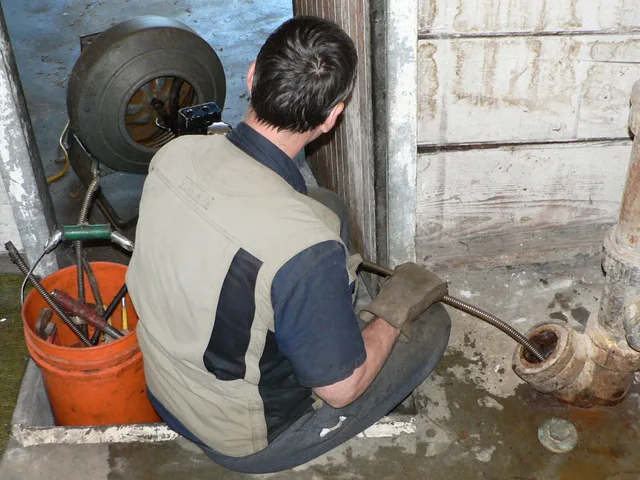
Drain cleaning. The standard says camera the line after clearing it. Practice clears it, watches it run, and leaves. The gap stays hidden until the same line backs up three weeks later.
Water heater replacement. The standard lists the expansion tank, relief valve discharge, and venting. Practice skips whichever one the last hundred installs never failed on.
Backwater valve work. The standard says confirm the permit rule with the local authority. Practice assumes the last municipality's rule applies.
Customers notice these gaps before the office does. Scoring what they see is the job of the service quality guide for owners.
Writing a standard from observed work
- Watch someone who does the job well and note what they do, not what they say.
- Write the draft the same day.
- Have a different person do the work from the draft alone, and mark every point where they asked or guessed.
- Fix those points, then date and version the standard.
Step three separates a usable standard from a document nobody can follow.
Hiring and what the customer sees
A shop with written standards brings a new technician up faster, because the answers live outside one person's head. Where the standard carries the sequence, hire for judgment and teach the sequence.
The arrival call and the closing summary are judged faster than the technical work.
How written standards change recruitment is set out in the hiring and training guide.
Code obligations, and the paper trail
Excavation, sewer entry, and hot work need their controls written into the steps of the job. OSHA's confined spaces page sets out what sewer entry requires, and its recommended practices for safety and health programs decide what stays at program level.
Never write a code requirement as though it were fixed. Write the step as a question to the local code official: is a permit required for this work here? The IPC or UPC sets the baseline and local amendments change it.
This article is written for the United States; the National Plumbing Code covers Canada.
Keep standards findable and current, the way the Internal Revenue Service asks financial documents to clearly show income and expenses.